Thoughts for April: In ‘Trying Times’
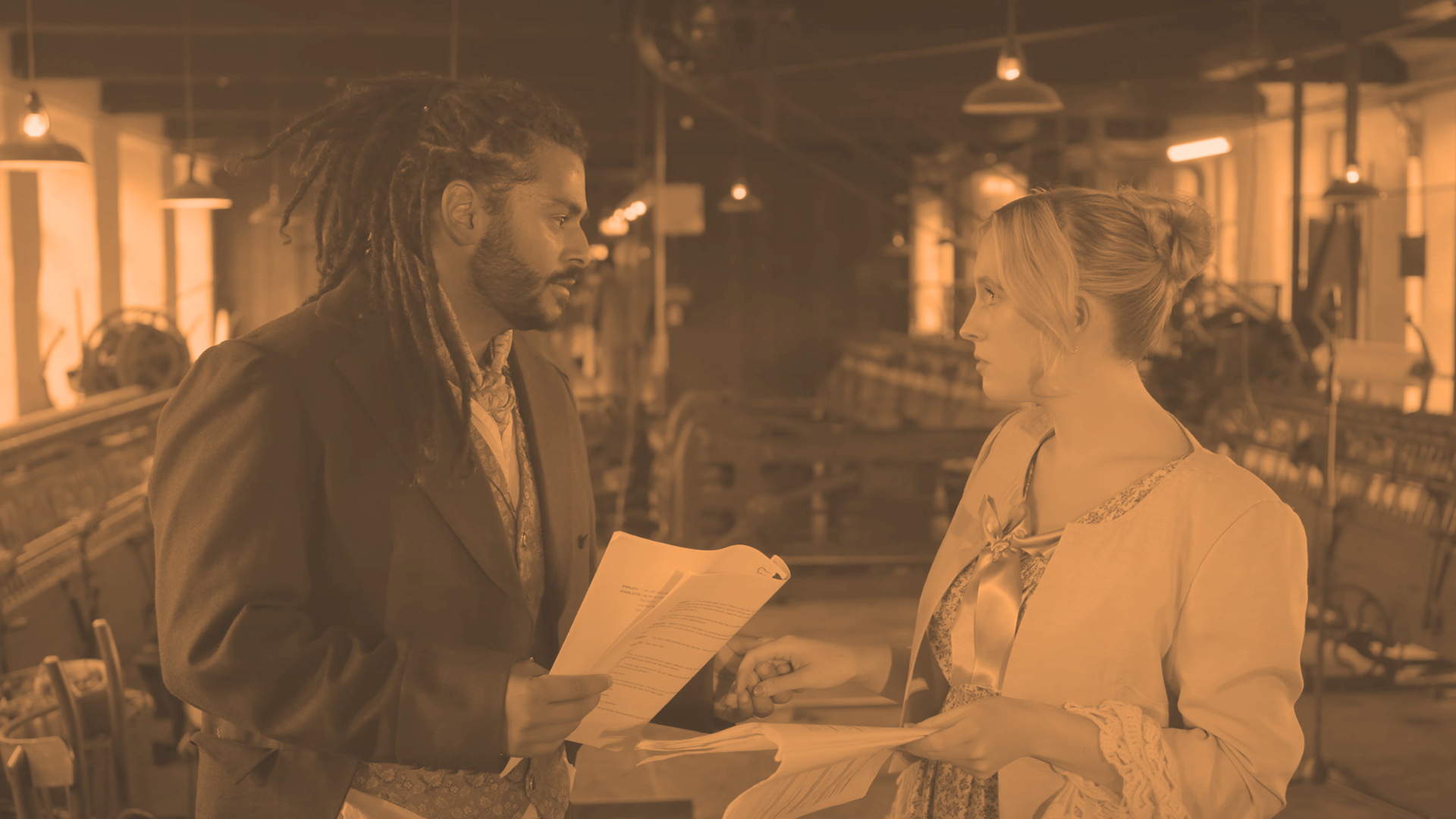
Dan Loops and Emily Snooks in R&D for Shirley: An Awakening in 2025. Photography by Pishdaad Modaressi Chahardehi
This month marks a year since we first tried ‘Thoughts For…’ It also lines up with recent releases of James Blake’s ‘Trying Times’ and Joshua Idehen’s ‘I know you’re hurting, everyone is hurting, everyone is trying, you have got to try’.
So we’re reflecting on trying, how we interpret what it means to try, and why it’s important to do so…
Seán & Beth:
Trying {adjective}
When I think about trying as an adjective, I do think about right now. In all honesty, I don’t think I’ve known a more trying time as now. This is a miserable thought as my living memory includes: the Bush war on terror; The 2008 financial crisis; Nick Clegg; Austerity 1.0 (the Cameron one); Trump 1.0; Brexit; Covid; Austerity 2.0 (the Starmer one); Trump 2.0; AI; X; The list goes on… I have a sense that the accumulative impact of these things has left a lot of younger adults feeling hopeless.
I sometimes wonder if hope, like an artisanal craft passed down through generations and communities, is at risk of leaving living memory.
This is a thing to rally against and be aware of, and to look for ways we can try in the face of trying.
I probably bore everyone with consistently referencing Rebecca Solnit, but I truly think she is the best savant for our ‘trying times’ (see my recommended watch below for more on this). I think I might have even made this specific reference in the blog before, so forgive me, but this is the truest of truisms I’ve found. In her seminal book Hope in the Dark, there’s this quote:
“Inside the word "emergency" is "emerge"; from an emergency new things come forth. The old certainties are crumbling fast, but danger and possibility are sisters.”
Bloody hell guys, once more for the people at the back:
Danger and possibility are sisters.
These times are trying. They’re trying me constantly with their cycles of injustice and cruelty. They’re trying me with their pace and their worshiping at the altar of productivity. But they're also trying me the swell of our relentless pushback, our resistance and our capacity for good. They’re trying me with the wonder and joy, of how we can still generate so much good in the face of so much hate. Inertia is the only real failure. The trying times force everyone to try. And so…
Trying {verb}
When I think about the idea of trying as a verb, the image of a small green being in a galaxy far, far away always comes to mind with the quote,
“Try not. do, or do not. There is no try.”.
I don’t want to be that guy who over intellectualises Star Wars through pseudo-psychology and misinterpreted wisdom (boys, it’s honestly just a fun film franchise and not the key to all knowledge)…
…But Yoda is sort of right, and sort of wrong.
There is a try, but in my book, trying is actually doing, so once you try something… You’ve done it. Right? You might not have done it very well, and there might be more to learn and better ways to execute it, but then you do (try) again… And you get a little bit better at doing the thing each time you try.
The key to doing (trying) is believing that something can be done.
Something I’ve loosely mentioned a handful of times on this blog, and spoken at length to anyone who will listen, is the process of songwriting and composition as a great example of trying.
In the last year, we’ve started working on Shirley: An Awakening. This has been the first time for a few years where I’ve been presented with a blank slate for a project. When we started, I realised that I’d forgotten how to work with a blank slate, and how challenging the generation of new ideas actually is. As opposed to working with consolidated notes, demos and road tested ideas (which does have its own challenges, but in comparison is fairly methodical).
The challenge of trying was probably compounded by the fact that, prior to this, the last time I had a set of new projects to work on, it was lockdown and I had unlimited time and no real external pressure to produce something or be anywhere.
The joy…
This time I was definitely in a spot where I was being pulled in lots of different directions, and to lots of different places.
There are a million and one different strategies, approaches and activities designed for and by songwriters and producers to kick into gear, and some are really great! But when it isn’t happening, it isn’t happening.
This is where trying comes in. We’ve set the things out we’ve rediscovered creatively as follows:
Inspiration is very rarely found on a computer:
Computers are good, the distance between the idea and the execution is far shorter than back int’ day. However, and this is a massive however, they very rarely are the source of inspiration that we need to kickstart an idea! You are only ever two movements of a mouse away from distraction, and, for musicians, Digital Audio Workstations have very clearly preconceived ideas of what you should be creating (is it just coincidence that Logic Pro X’s default key and tempo of has corresponded with a huge uptick in the amount of music in C Major at 120 beats per minute…?). I’ve definitely tried moving away and into other spaces and areas to generate ideas, with some positive results that have definitely been a palate cleanser for the creative process.
Collaboration is key:
Believing you can go it fully alone is anti-human. That beautiful metaphor that humanity started, not in the building of settlements or cities, but when there was physical evidence of people healing from injuries because others stayed and helped: that’s key to our creativity as well as our survival.
If something is hurting - reach out for help. So many artists I’ve talked to worry so much that someone’s going to steal their idea and so don’t reach out for collaboration. In my mind, the best ideas are big umbrellas, with room for us all to shelter under.
Sometimes you're a hunter; sometimes you’re a farmer:
There’s a philosophy that all composers/songwriters fall into one of two categories: The Hunter or The Farmer. The hunter lies in wait for inspiration to strike before feasting on it and waiting for the next strike; whilst the farmer cultivates ideas, cross pollinating and experimenting seasonally to produce unexpected, accretive results. I mostly agree with this, but do think that most people can also be either of these, and in trying to be present with where you’re at creatively on any given day, you can adapt yourself to either the hunter or the farmer role.
Ideas aren’t the be-all-and-end-all:
A joy we found early on as a process of making work as a company is fighting to find the worst idea rather than the best, as a process of getting out of your own way. These have included: the idea for a trumpet to be birthed on stage; people wearing coats backwards (this actually made it into an industry sharing); or making our adaptation of Shirley all about the bit where she thinks she has rabies.
The point of this is that ideas shouldn’t be cherished like they’re finite. They’re just a collateral commodity in the room: to be traded, discarded or invested into something that can be evolved as the process moves. It’s also a great thing for ego, to know we all have equal capability for great and bad ideas. You should welcome both as playfellows that will enrich the process.
Fishing is an important skill:
There’s a quote that gets passed around a lot: “All the songs are out there, you’ve just got to catch them before Paul Simon does” The basis of this is that inspiration exists, it just has to find you working. I call this going song fishing. I’ll let myself kill an afternoon with an instrument and microphone, with no expectation that I’m going to catch. This psychology makes a catch so much more rewarding and even small snippets of ideas result in a real sense of elation. This is definitely an aspect of trying that I’ve had to relearn this year, and I feel much better for it.
Last year was definitely one back on the bike for me too (ironic since I never actually learned to ride a bike). If you know me personally, you might know where I was at both with my mental and creative health in late 2024/early 2025. If you don’t know me, the long and short is that I didn’t know if this industry was right for me anymore. And that felt really scary to say when there’s lots of toxic conversation in this industry that if you’re not constantly hungry for it or killing yourself for it, you don’t deserve it anyway. But that is feeding yourself on poisoned fruits. No one should want to be in a space that hurts them.
Eventually, alongside a lot of grieving and reckoning, I decided to try again. And beginning to make Shirley: An Awakening, with a group of people who wanted me to try and supported me to try, was a wonder for me. That should be the glory of R&D, the trying is the whole thing.
And then I went to a masterclass with the incomparable Emma Rice (my literal theatre icon, I will never articulate how much this meant to me). And she talked, with stunning honesty, of the few times she didn’t feel like she could do this anymore. But then she was presented with the question, that years before Nick Hytner had dropped at her feet, “Is this going to stop you trying to make work?” And as long as the instinct of her answer had some feeling of ‘no’ in it, she went on.
And god that muscle of trying is now the one I can feel working the most. At the beginning of this year, I was hit again with the anniversary of feelings of the year before - you’ve got to love the sneakiness of grief - alongside the smack of two big funding nos. So again came creeping the not-so-soft voice of ‘Can I? Can I possibly go again?’. But that muscle kicked in. And then I saw this floating around, like a missive, on a post from @pitkeeper on Instagram, taken from Culpable by Joy Sullivan
“No matter which road you take, it will be both glorious and unbearable.
Every road is lonely.
Every road, holy.
The only error is not walking forth.”
Luminous beings are we. It’s important that we actively remember that and try.
Seán recommends:
A read: As a trailer for some of the tech and luddism themes we’ve got coming up in our work, I’m going with Yanis Varoufakis’ Techno-Feudalism: What Killed Capitalism. It’s a couple of years old but a good way into some quite complex ideas to comprehend.
A listen: I have a thing with songs. Sometimes a single song hits differently and becomes my entire music taste for a few days and is the only thing I listen to, on repeat. This obsessive behaviour goes beyond analysis and I’ve learned to just roll with it. I’ve had this happen this week with James Blake’s Just A Little Higher. The rest of Trying Times is excellent, too. Give it a listen, just not on Spotify.
A watch: It’s not out yet in the UK, but I’m really looking forward to The AI Doc: Or How I Became an Apocaloptimist. In addition to the fantastic title, I’ve heard some really interesting things about it.
An event: This weekend is the 2026 Sheffield Folk Sessions Festival. A free weekend of folk sessions in pubs across Kelham Island you say?
Beth recommends:
A read: Full of humanity, full of trial and error; my mum - in her infinite wisdom - bought me the duly acclaimed The Correspondent by Virginia Evans for my birthday, and I tore through it in days. Can someone option the film and cast Glenn Close as the lead immediately, thanks??
A listen: Switching from Spotify to Qobuz is good for my ethics and soul but bad for my reliance on the algorithm to recommend things I like. ButFor Mary by Olive Jones was one of their critics picks, and reader - I loved it. Turns out finding things is easy when you try a bit - who knew?
A watch: Hopefully I’ve made myself clear enough on why Rebecca Solnit matters. So watch her on The Interview from the New York Times.
An event: I’m beyond excited to see Kiss of the Spider Woman at Leicester Curve. Not only is it the brilliance of Kander and Ebb (yes I am a Cabaret and Chicago girly - please let me get my hand on either piece at some point in my career directing gods!!), but it unites two of the kindest and most brilliant artists I’ve ever had the joy of working with: my directing icon Paul Foster and my acting hero George Blagden. I cannot overstate this: you MUST see it at Leicester or on tour to Bristol and Southampton.