Thoughts for March: The Price of ‘Bad’ Work
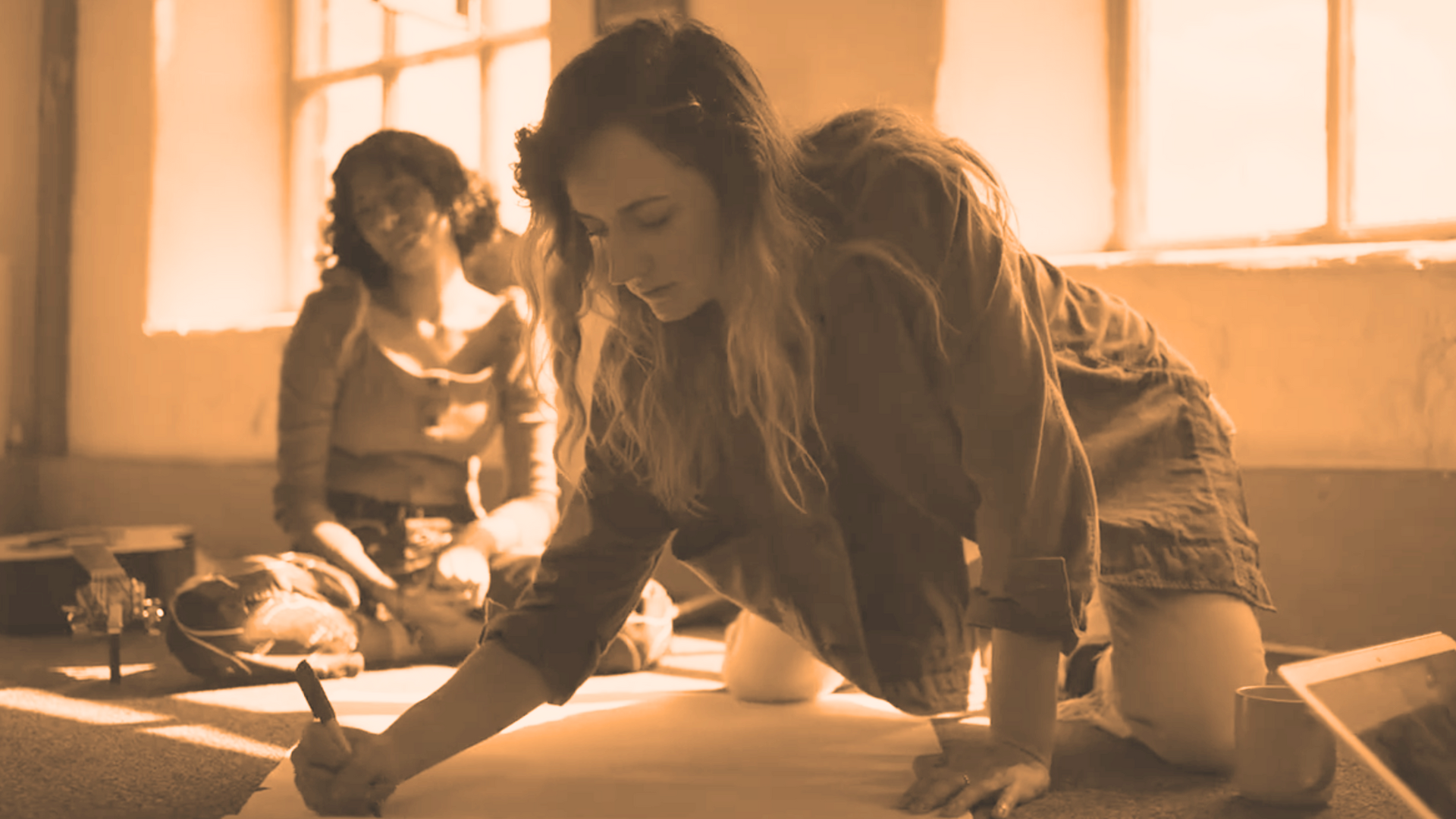
Shreya Patel and Beth Knight in Mother of the Revolution R&D in 2021. Photography by Pishdaad Modaressi Chahardehi
This month, after binge reading the reviews of “Wuthering Heights”, but not getting funding (yet) for our own Brontë adaptation, we’re thinking about the price of making and its cost on our right to make ‘bad’ work.
Beth:
I preface all of this with admitting that I haven’t seen Emerald Fennell’s “Wuthering Heights”. I’ve only read the reviews that me and Brid (Shirley: An Awakening’s writer and, very ironically, who I sat next to in A-Level English Lit lessons while we studied Emily Brontë’s novel together as teenagers) have been sending each other for the last few weeks.
I also preface all of this blog with the great big funding grief™ of being rejected from the major funders, who without getting funds from, our new work cannot get made. (See last year’s May blog for more on how I might be feeling/coping right now, and to know how this is just the vicious cycle we’re all - mostly stuck - in).
But here’s my instinct on Robbie/Elordi/Fennell/Brontë mania:
Where even my local was offering Cathy and Heathcliff cocktails on Valentine’s weekend;
Where these leads are canonically northern and non-white respectively but were both cast as white Aussies;
Where the film has recouped almost 2.5x its massive $80 million budget at the Box Office so far;
And where Clarisse Loughrey’s scathing 1 Star review in the Independent prosecutes that Fennell “uses the guise of interpretation to gut one of the most impassioned, emotionally violent novels ever written, and then toss its flayed skin over whatever romance tropes seem most marketable.”;
This, reader*, is a story
- more actually like Emily Brontë’s 1847 original -
of cash and privilege.
(*yes this is from Charlotte’s not Emily’s playbook, but go with me)
Because Emerald Fennell who, like so many in our industry, spent her life in private education, was born and grew up in London, is from the white upper classes where her wikipedia page has clickable links to her father’s own wikipedia page, will never have her employability touched by any uproar of low-star critical reviews.
Will never have her budgets cut by the furore caused by her casting by appropriation.
And will continue to think herself “lucky” for opportunities like Wuthering Heights, like she said she felt about one of her many big breaks in being promoted to Head Writer by her mate Phoebe Waller-Bridge on Killing Eve, when what that ‘luck’ really is - is talent, yes - but most essentially is privilege.
(And I don’t mean to shit solely on her. I know this may lever charges that a male auteur/writer/director wouldn’t come under such scrutiny for their privilege. To which my only response is, yes they bloody should. I’m happy to tell you my Top 20 horrid male privilege stories in the industry over a glass of wine anytime.)
But really the crux of really what I want to say is, we need to talk about how independent artists, without those privileges, aren’t allowed to make ‘bad’ work.
And this doesn’t mean that we don’t make bad work. Work that audiences don’t like, is critically panned, is unfinished, goes through horrible processes, or doesn’t meet the mark in so many ways.
But our ability, our opportunity, our privilege to try and fail and try again (and fail again) are finite.
And opportunities for us are scarce and just getting scarcer.
The number of plays and musicals produced by major subsidised theatres has dropped by roughly 31% over the past decade with a 44% decline in new work on stages outside London, and whilst applications to the Arts Council Project Grants programme dropped by 11% between 2023/24 and 2024/25, the success rates of these fewer applications also dropped by 7.21%.
To manufacture some kind of privilege to make work and then make work again means bottling the formula for success.
I don’t know any peer in similar positions to us who isn’t considering every project with a 360 degree view of impact and external perception, creating solutions rather than space for creative experimentation.
Who isn’t spending days/months in perilous positions crafting a best face to put forward for networking, emailing, pitching and applying, to try and get a foot in the door for any opportunity.
Who doesn’t feel like the bottom is falling out of their life, world, purpose, career when something goes awry, when someone shuts the door behind them, or when you sift through the majority of ‘unfortunately we won’t be continuing… we can’t provide feedback’.
And who feels like any ‘luck’ they do have is only seconds away from running out.
And so how do we move forward?
We admit this isn’t as meritocracy.
We name the privilege.
And when we have privilege we pass it on.
In opening myself up to this, here is my honest statement of my own privilege:
I am a white, cis, woman. I have only ever lived in Yorkshire and have never lived in financial or housing insecurity. I am from a first generation middle class household. I’m currently seeking a private ADHD diagnosis that I can only just about afford, understanding of ADHD - especially in women - was very different when I was a child when it should have been, and is easier to get, diagnosed.
I went to state school up to A-Level but not University and haven’t ever formerly trained in the creative practice I have now. I did an Apprenticeship in Arts Administration at my local theatre at the age of 21/22, a theatre that had loads of opps for young people when I was young (I’m turning 32 tomorrow so tragically relinquishing my rail card and ‘young’ status). Most of the opportunities I had to develop and get work early in my career came from people who got to know me and opened a door to a new room or to learn from their work.
None of my family have anything to do with the arts, but my parents let me live rent free at home plenty of times when I was working things out/working for free/trying to dig into getting jobs in the industry. I’ve had periods of bad mental health and anxiety and I’ve been through fairly regular periods of therapy since I was 20.
I’m happily married. I own a house. And right now, with the money in our reserves, I can pay myself to work 3 days a week for the next 4 months. I’m being paid to write this blog. I am being paid to write applications, to meet with artists and to plan projects. I regularly feedback to artists about their ideas, projects, applications if they want some help. If you want me to do that for you, email me at beth@archipelagoarts.co.uk.
I am terrified about how I’ll pay my bills if we get another big funding no. I didn’t get any of the jobs or development opportunities I applied for last year, and I only got past a first stage rejection for 2 things. I did get jobs through my established networks, I got a promotion at a job I got through previous open call and I got work through applying for funding. I haven’t put money into a pension since I went fully freelance in 2021. I spent 9 years working in the industry (3 of them unpaid when I worked in retail) until I could go freelance.
And I hope it isn’t news to state this for the record. I hope most rooms I go into, especially when there’s artists less established in their careers than I am, have heard some version of this from me. I feel like a broken record, but I truly think that toxic competition is rotting the industry; and that’s because of scarcity mentality. And like I’ve said, that scarcity for most of us is real. But a way we develop a bounty is to be bountiful. When we get funding we pay people, that is by far our biggest expenditure. We make jobs and space. We try to do that for people we do and don’t yet know.
But really, my only infinite resource is honesty. And I don’t know if these thoughts or feelings I’ve just let you in on are worth anything to you. But maybe if all of us can be a bit more honest about what we do and don’t have, what we do and don’t need, things might feel a bit clearer. A bit fairer?
And then all of this won’t feel like it costs so much.
(That or an $80 million budget for our own Brontë adaptation would be nice.)
Seán:
Off the back of Beth’s provocation to opening up about privilege, here’s some reflections on my own:
I have a set of quite visible, obvious privileges. I’m a White, CIS Man with a university education. I’ve been able to, with scholarships and grants, study to post-graduate level and work in cultural settings abroad. I don’t take these opportunities or doors that are open to me for granted, my family’s experiences are ones of immigration and working class dedication and these are new opportunities to recent generations.
Before going to University a bit later than most, I grafted hard to get into vital cultural spaces to develop music production skills. I did a vocational course at the only civic-run recording studio in UK, which luckily was where I grew up in Sheff. That resource has now gone. I taught there when it closed and it had only just managed to tick over to a point where female music production students made up 50% of the cohort. This is a loss not only for women to get into a industry where they are still desperately underrepresented, but for our northern and national talent pipeline in general.
A huge wealth I did have growing up was my access to culture. I grew up in house where my parents encouraged debate, wanted to hear what I had to say on a range of subjects from when I was really young, had loads of books around, wanted to watch films together and encouraged me into and provided support for me to access music and sport. I also got used to being challenged to understand that what I was doing with my time was what I wanted to do; that my time didn’t always have to be productive or purposeful (it sometimes did, and does!) but the non-negoctiable was that my time was well invested and fulfilling. Without this, I would 100% have ended up as a Quantity Surveyor…
Beth recommends:
A read: If you want to dive into more on this theme, UAL and Artsquest released this fantastic report in October entitled Who Gets to be an Artist? with some really clear recommendations for the future of a more equitable arts industry. Or if that’s is too bleak, I finally read Sally Rooney’s Intermezzo, which is also pretty bleak but as devastatingly beautiful as everyone says.
A listen: Today is the full release of Joshua Idehen’s debut album
I know you’re hurting, everyone is hurting, everyone is trying, you have got to try (which I think is the best title of an album I’ve heard in ages). For any knock I’m feeling at the moment I have already been repeatedly playing his early release from the album Don’t Let It Get You Down to pick me back up.
A watch: I’ve sobbed my way through (with sadness and laughter) rewatching Catherine O’Hara in both Schitts Creek and The Studio. Really, as Seth Rogen said in collecting her posthumous SAG award for the latter at the weekend “We are lucky we got to live in a world where she so generously shared her talents with us”. Treat yourself to anything in her canon. Or on the subject of awards, this clip of her presenting an Emmy in 2024.
An event: Anyone in London is in for a treat this month as the brilliant George Naylor delivers a masterclass in the extended monologue in Tim Foley’s brilliant It Walks Around the House at Night for ThickSkin playing at Southwark Playhouse. SO spooky and so socialist. Ideal.
Seán recommends:
A read: I picked up Parade by Rachel Cusk thinking “Nice, a short book I can get through quickly”. A month later I’m still enjoying working through one of the most compositional complex and dynamic books I’ve read for a long time.
A listen: The Mountain is peak, eclectic, star studded Gorillaz. Some collaborators are alive, others are not. Albans and co’s ever pushing of song structure, genre and form.
A watch: Shrinking, Season 3. As well as all the things people love Shrinking for, I’m really enjoying only being able to watch this one episode a week and look forward to watching it weekly on a Wednesday.
An event: The inaugural Kelham Jazz Festival is coming up on 21st March. Jazz, nice 👌